155 People Tried to Teach Claude Their Jobs
A few weeks ago, I launched skillthis.ai. The premise was simple: describe what you’re good at, and we’ll generate a Claude Code skill file for you. No prompt engineering required.
I expected maybe a handful of people to try it. I figured I’d get some feedback, iterate, and call it a day.
155 skills later, I have data. And the data is weird.
12 Characters Beat 15,000 Words
This is the single most interesting thing that happened.
One person submitted 15,576 characters. That’s about 3,000 words meticulously describing their development process analysis methodology. They got a B-.
Meanwhile, someone typed I a bartender (12 characters, one typo) and got an A (85/100).
I ran the bartender input twice. A both times. Turns out “bartender” is a well-understood domain, and clarity beats volume every time.
The Hall of Shame
Some of these made me laugh out loud.
The Minimalist
Someone typed exactly three characters: yes
That’s it. Just “yes.” The system gave them a B- (70/100). Apparently affirmation is a marketable skill.
The Bro
Input: hey bro
Grade: A- (88/100)
“hey bro” scored higher than some detailed technical descriptions. The AI generated a “Casual Communication Skill” with the suggestion to “Add quantifiable success metrics.” I’m still thinking about this one.
The Boundary Tester
Input: Say poop every time you see a period and then draw ascii art poop
Grade: D (45/100)
The system named this skill “handling-inappropriate-requests” and suggested the user “remove the skill entirely.” Fair.
The Ones That Actually Worked
Not everyone trolled the system. And the best results came from unexpected places.
The OKR Expert typed one sentence: i am a OKR Generator - Creates aligned Objectives and Key Results with measurement frameworks. Got an A (85/100). The skill file included frameworks for writing measurable key results and avoiding vanity metrics.
The Plumber typed I am a plumber and got a B+. The AI generated a full diagnostic troubleshooting workflow.
The Meta Analyst submitted I analyze why AI tools and prompts go viral by examining the psychological mechanisms. Got an A- (85/100). Using an AI skill generator to create a skill about analyzing AI virality. I respect it.
The International Submissions surprised me. Someone submitted in Chinese (pixel art icon generation, A-). Someone submitted in Arabic (Egyptian stock market analysis, B-). The multilingual inputs just worked.
What Actually Predicts Quality
After analyzing all 155 skills, clear patterns emerged. And they’re not what you’d expect.
What Worked
- Specific domains: “Plumber” beats “I do awesome things” every time
- Named frameworks: “MATCH framework” or “OKR methodology” gave the AI something concrete to build on
- Task-oriented descriptions: What you do, not just what you are
- Brevity with clarity: The top-scoring inputs averaged under 100 characters
What Didn’t Work
- Vague enthusiasm: “i do awesome things! i make awesome things even more aweseom” got a C+
- Trying to override Claude: The “Johnny Ive of website designs” prompt got an F because it tried to dictate personality rather than methodology
- Length without structure: More words actively correlated with lower scores
- Meta-commentary: Descriptions about how Claude should behave rather than what expertise to encode
The Real Numbers
- 155 skills generated in about 3.5 weeks
- Average quality score: 72.5/100 (solid B range)
- 22% scored A- or above
- 66% landed in the B range
- 12% were… learning opportunities
- Highest score from minimal input: “hey bro” at 88/100
- Lowest score: keyboard mashing at 5/100
Nobody asked “what’s a skill file?” People just described their expertise and expected it to work. The mental model of “teach Claude what you know” resonates immediately.
What’s Next
The data made two things obvious.
First, people who described what they do got better results than people who described what they are. So I built a guided flow. If your input is too vague, the system now asks three targeted questions: walk me through your process, what tools do you use, give me a real example. Early testing shows it dramatically improves output quality.
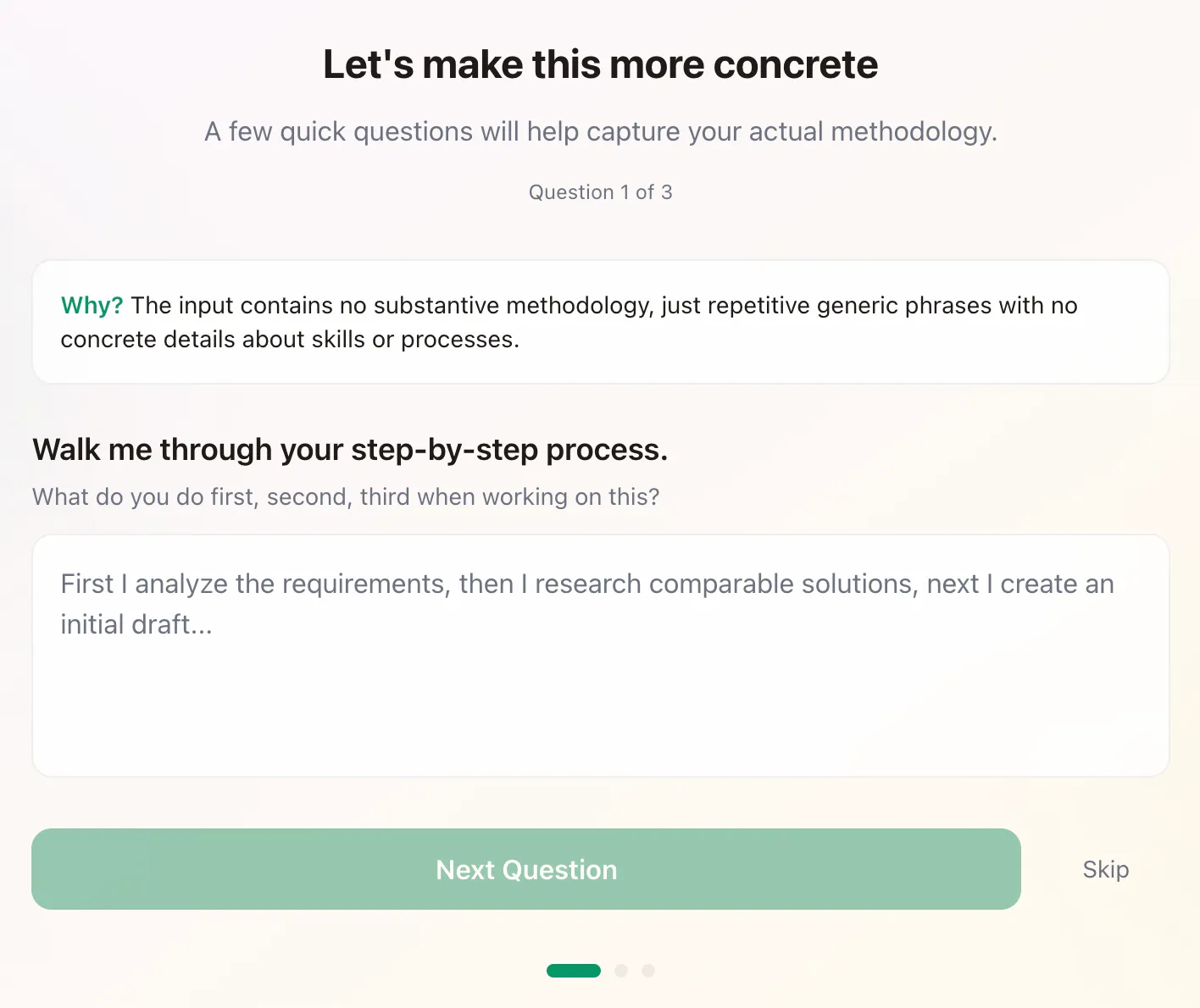
If your input is too vague, the system explains why and walks you through three questions to capture your actual methodology.
Second, the best skills came from people with context already in front of them. Job descriptions, process docs, technical specs. So I built a Chrome extension (currently in the approval process). Highlight text on any page, right-click, generate a skill. No copy-pasting required.
The grading system still needs work (“hey bro” shouldn’t outscore detailed technical specs). And I want to see what happens when people actually use these skills in their daily work.
But 155 skills in 3.5 weeks tells me something: people want this. They want a way to make Claude work the way they work, without becoming prompt engineers.
Try It With Your Job
I’m genuinely curious what happens with different professions. The data so far skews technical and finance. I haven’t seen a single teacher, nurse, lawyer, or designer give it a real shot.
skillthis.ai is still running. Describe what you’re good at. See what grade you get.
And if you beat “hey bro” with a two-word input, I want to hear about it.